
The VOP API specifications include a number of timestamp fields in the headers and body. The format of these timestamps does not allow for trailing zeroes for milliseconds.
A PSP or RVM can decide to nevertheless accept messages with trailing zeroes in milliseconds in the timestamp fields of the API messages it receives, however, a PSP or RVM should not send a message with trailing zeroes in the milliseconds of a timestamp field, as this can indeed lead to a rejection of the message by the receiver with reason Invalid Format.
The following paragraphs provides a clarification and justification of this rule.
The timestamp format is defined in the VOP API Specifications document (https://www.europeanpaymentscouncil.eu/document-library/implementation-guidelines/verification-payee-scheme-inter-psp-api-specifications) as follows:
The X-Request-Timestamp header must contain a valid ISO 8601 timestamp string, expressed in either UTC time format (YYYY-MM-DDThh:mm:ss.sssZ) or local time with UTC offset format (YYYY-MM-DDThh:mm:ss.sss+/-hh:mm), milliseconds included, as defined in "XML Schema Part 2: Datatypes Second Edition - W3C Recommendation 28 October 2004" (https://www.w3.org/TR/xmlschema-2/) which is aligned with ISO 8601
The referenced W3C recommendations include the following specification in paragraph “3.2.7.2 Canonical representation”:
Except for trailing fractional zero digits in the seconds representation, '24:00:00' time representations, and timezone (for timezoned values), the mapping from literals to values is one-to-one. Where there is more than one possible representation, the canonical representation is as follows:
- The 2-digit numeral representing the hour must not be '24';
- The fractional second string, if present, must not end in ‘0’;
- For timezoned values, the timezone must be represented with 'Z' (All timezoned dateTime values are UTC.).
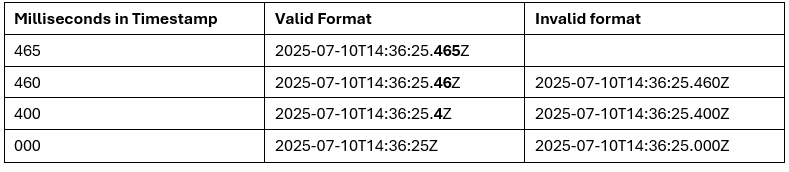
The second bullet point concretely means trailing zeroes in milliseconds are not allowed.
The following examples illustrate the correct notation:
For information, the same format for timestamps based on the W3C Recommendations is used in the ISO20022 XML specifications, supported by the XML element type “ISODateTime”.
The EPC included this in a SEPA Usage Rule (which refers to W3C) and defined a regular expression (regex) for the XML element type “ISODateTime” which ensures no trailing zeroes are used for milliseconds: [0-9]{4}(-[0-9]{2}){2}T[0-9]{2}(:[0-9]{2}){2}(\.[0-9]{0,2}[1-9])?(Z|([-+][0-9]{2}(:[0-9]{2})?))