
Background: services that can be offered by PIs
Payment Institutions1 (PIs) may engage in the following activities under the relevant EU regulatory framework:
PIs are authorised to provide payment services provided under PSD2 (Directive (EU) 2015/2366):
a) Payment services set out in Annex 1 of PSD2, including Euro Credit Transfers and Direct Debits. These services are governed by the SEPA Regulation (Regulation (EU) 260/2012) and PSD2 and include:
- provision of payment accounts which are used for the execution of payments, that are accessible for payment initiation and receipt;
- provision and execution of credit transfers (SCT/SCT Inst) and/or direct debits (SDD/SDD B2B) to Payment Service Users (PSUs).
b) Payment Initiation Services (PIS). PIS require that permission be obtained by the PI as part of a variation of the license process.
PIs that can/should adhere to the EPC payment schemes
There are several types of transactions offered by a PI to its clients. To determine whether a PI should adhere to the EPC SEPA payment schemes, it is essential to assess whether the PI meets the eligibility criteria (section 5.4 of the schemes on Eligibility), which include offering to their PSUs payment accounts as defined under Article 4, par (12), PSD22 – and in line with the interpretation provided by the EU Court of Justice (CJEU) in case C-191/1743 , and importantly whether the relevant payment transaction falls within the scope of the SEPA Regulation, based on Article 1, par (2), (f).
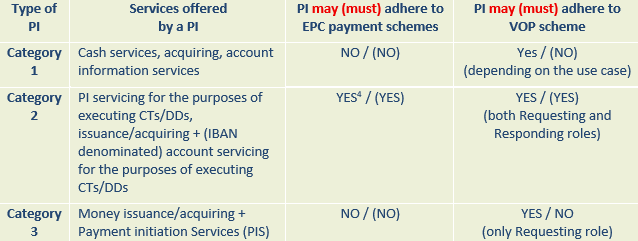
Depending on the outcome of the assessment, three main categories of PIs can be identified:
1) Category 1: PIs not carrying out payment transactions in scope of SEPA
These PIs typically offer the following services (Annex 1, Directive (EU) 2015/2366):
1. Services enabling cash to be placed on a payment account as well as all the operations required for operating a payment account.
2.Services enabling cash withdrawals from a payment account as well as all the operations required for operating a payment account.
…
8. Account information services.
2) Category 2: PIs carrying out payment transactions in scope of SEPA
These PIs typically offer the following services (Annex 1, Directive (EU) 2015/2366):
3. Execution of payment transactions, including transfers of funds on a payment account with the user’s payment service provider or with another payment service provider:
(a) execution of direct debits, including one-off direct debits;
(b) execution of payment transactions through a payment card or a similar device;
(c) execution of credit transfers, including standing orders.
4. Execution of payment transactions where the funds are covered by a credit line for a payment service user:
(a) execution of direct debits, including one-off direct debits;
(b) execution of payment transactions through a payment card or a similar device;
(c) execution of credit transfers, including standing orders.
5. Issuing of payment instruments and/or acquiring of payment transactions.
6. Money remittance.
…
3) Category 3: PIs offering Payment Initiation Services
If a PI does not carry out payment transactions in scope of SEPA, but is duly authorised to provide Payment Initiation Services (PIS), such a PI could adhere to the VOP scheme as a Requesting PSP.
Adherence of PIs to the VOP scheme
The eligibility of PIs to adhere to the VOP Scheme is linked to the nature of payment transactions they carry out and whether those transactions fall within the scope of SEPA Regulation.
Adherence to the VOP scheme, however, has specific fraud related objectives that may extend beyond the reachability criteria for the SEPA payment schemes. In other words, the legislators recognised that it would be beneficial to payment services if the Beneficiary of a payment transaction destined to a payment account that is not identified by an IBAN, could still be identified by the VOP scheme. This has been contemplated by the Instant Payment Regulation and implemented through the VOP scheme Rulebook, in allowing for additional means of identification. In this case, PIs falling under Category 1 above may still decide to join the VOP scheme.
The primary criteria to determine whether or not a PI is required to adhere to the VOP scheme is whether or not this PI carries out or receives payment transactions in scope of SEPA Regulation.
If PIs offer Payment Initiation Services (PIS) and provided that they are duly authorised to provide PIS under PSD2, in line with the provisions of Article 5c, par (2), amended SEPA Regulation, these PIs must ensure that the information concerning payees they provide to the payer’s PSP is correct, and this may be achieved by adhering to the VOP scheme as Requesting PSPs.
PIs offering only money remittance or RTGS transactions in Euro outside the SEPA framework. It may be useful to clarify that such entities may not join the Payment Scheme, nor the VOP scheme, even as a requestor only.
Annex – Overview Use Cases Table
Disclaimer
The information provided in this text is for informative purposes only and does not constitute legal advice. Payment service providers should act upon any information contained herein only after seeking professional counsel from a qualified attorney licensed in their jurisdiction to determine the schemes to which they would be required to adhere to comply with applicable law.
1 PIs as defined under Annex 1 of the Payment Services Directive (Directive (EU) 2015/2366).
2 "an account held in the name of one or more payment service users which is used for the execution of payment transactions."
3 To qualify as ‘’payment account’’, an account must allow the account holder to make payments to third parties, or to receive payments from third parties.
4 Even in case of “indirect” participation through an intermediary/sponsor bank